Getting started
Install
BizMap needs Python 3.11 or newer.
pipx installs it in its own environment and puts
bizmap on your PATH. Nothing else is required: no database connection, no
account, no network.
Scan the demo
bizmap-demo is a small, fictional shop with two services that share one Postgres database:
bizmap-demo/
├── bizmap.yaml          workspace: repos [shop, payments] + services
├── shop/                TypeScript + Express + pg
│   ├── src/             routes, orders, inventory, checkout, payments client
│   └── db/              schema.sql + migrations (a status-history trigger)
└── payments/            Python + FastAPI + SQLAlchemy
    ├── app.py           /charges, /webhooks/provider
    └── migrations/
At checkout the shop calls POST /charges on payments; when the payment
provider confirms, payments calls POST /orders/:id/paid back on the shop.
A database trigger records every change of orders.status.
git clone https://github.com/lucas-simao/bizmap-demo && cd bizmap-demo
bizmap scan . --mermaid
bizmap who-writes orders.status     # who writes this column, from which entrypoint
bizmap trace orders                 # where the data comes from and where it goes
bizmap why orders.status            # everything around the column at once
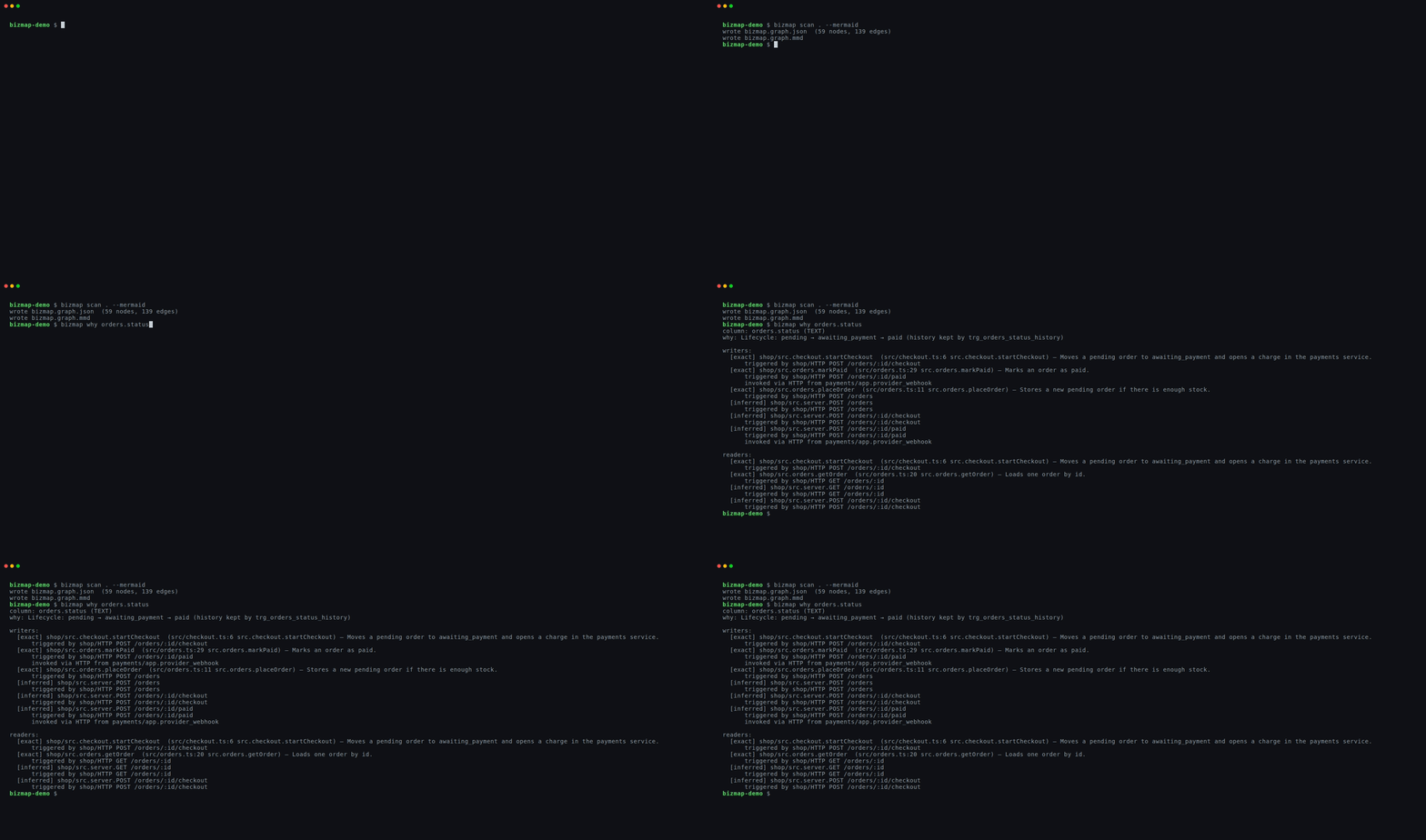
bizmap scan . reads the workspace bizmap.yaml, scans shop and
payments together and writes bizmap.graph.json (plus
bizmap.graph.mmd with --mermaid). The questions then answer from that
file.
Ask: who writes, who reads, trace
bizmap who-writes orders.status              # add --path for the full call chain
bizmap who-reads orders --format md          # text (default), md or json
bizmap trace orders --depth 2                # upstream and downstream
Each writer is shown as entrypoint → (via N functions) → the function that
writes, with the columns, the confidence, the repo and file:line. A name
that matches several things (a Firestore collection and a Postgres table both
called orders) lists the candidates instead of picking one, and every answer
ends with what could change it (unresolved names, URLs and queues). Details:
who-writes / who-reads / trace.
Open the HTML page
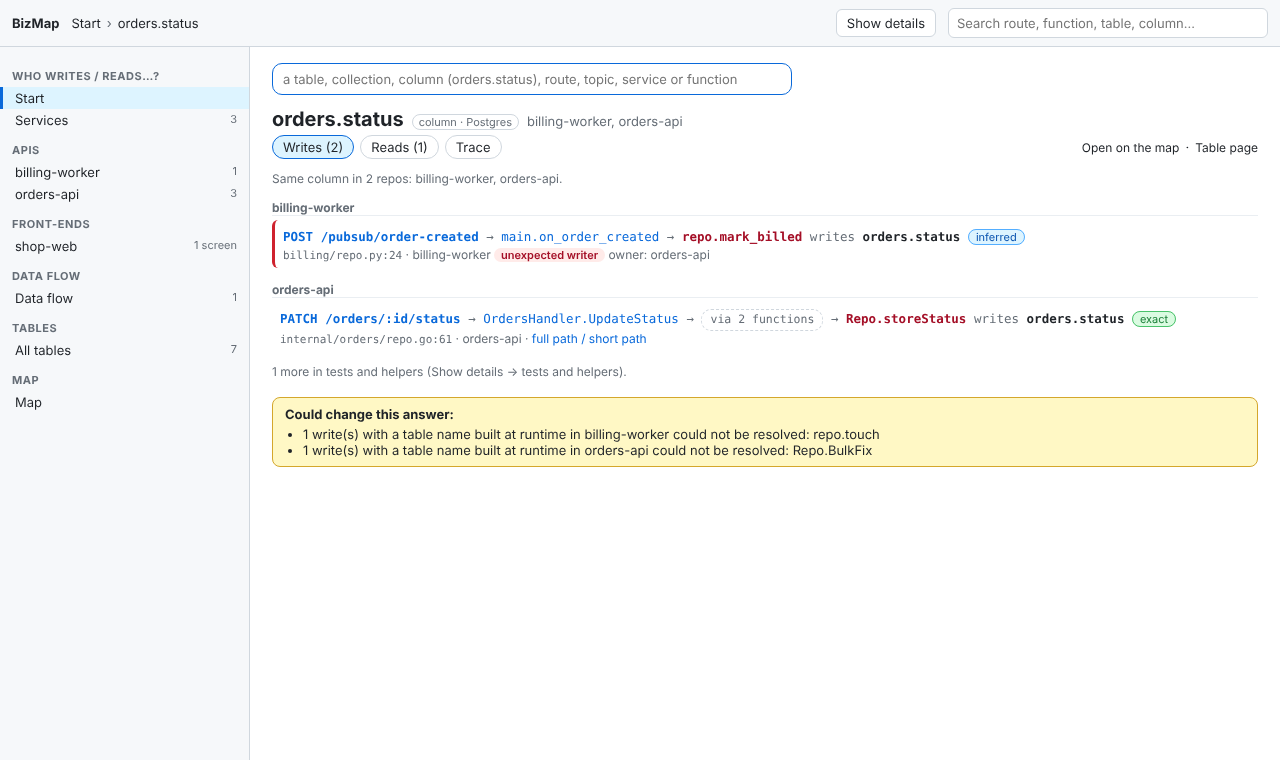
One offline file that opens on who writes / reads X?: type orders.status,
press Enter, and the writers are listed the same way as on the command line.
Below it: a summary strip, findings (an unexpected writer, tables written by
several services, names built at runtime, orphan functions), a services ×
tables matrix and a Mapa tab around one entity. See
the start screen.
Everything around one column: why
bizmap why orders.status prints every writer, reader, trigger and caller at
once:
- three functions write
orders.status, each withfile:lineand the comment above it; markPaidis triggered byPOST /orders/:id/paid, which is invoked via HTTP frompayments/app.provider_webhook— a different service, in a different language;[exact]is SQL in that function;[inferred]was carried up to the route handler that calls it.
The trigger shows up on the table it writes:
$ bizmap why order_status_history.new_status
column: order_status_history.new_status (TEXT)

writers:
  [inferred] shop/src.orders.markPaid  (src/orders.ts:29 src.orders.markPaid) via db_trigger:trg_orders_status_history — Marks an order as paid.
      triggered by shop/HTTP POST /orders/:id/paid
      invoked via HTTP from payments/app.provider_webhook
  ...

defined/altered by:
  [exact] db trigger trg_orders_status_history on orders  (db/migrations/001_order_status_history.sql:18 trg_orders_status_history)
  [exact] shop/log_order_status  (db/migrations/001_order_status_history.sql:10 log_order_status)
An UPDATE orders SET status = … in the shop is enough for BizMap to know
that order_status_history is written too, and by which routes.
Check what it understood
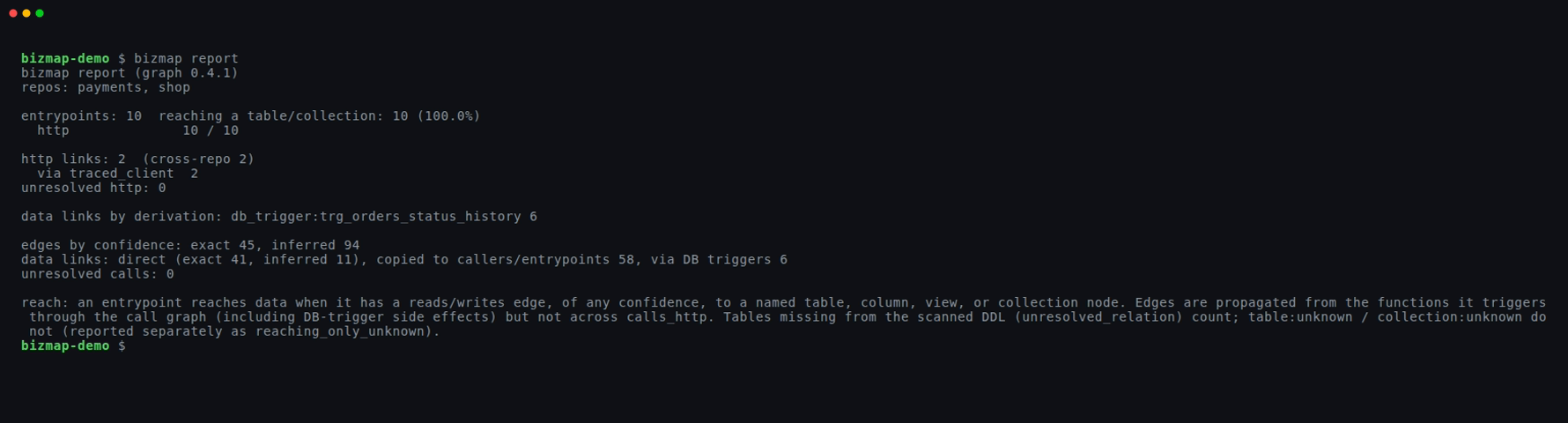
All 10 routes reach a table, both cross-service calls are linked, nothing is unresolved. On your own code, start here: the report says what BizMap could not link and why.
The diagram
--mermaid writes an entrypoint → table rollup, one box per service, with
the HTTP calls between them. This is bizmap.graph.mmd for the demo, as written:
flowchart LR
  subgraph payments
    payments_entrypoint_http_GET__charges__charge_id_["GET /charges/{charge_id}"]
    payments_entrypoint_http_POST__charges["POST /charges"]
    payments_entrypoint_http_POST__webhooks_provider["POST /webhooks/provider"]
    table_payments["payments"]
  end
  subgraph shop
    shop_entrypoint_http_GET__customers__id["GET /customers/:id"]
    shop_entrypoint_http_GET__inventory__sku["GET /inventory/:sku"]
    shop_entrypoint_http_GET__orders__id["GET /orders/:id"]
    shop_entrypoint_http_POST__customers["POST /customers"]
    shop_entrypoint_http_POST__orders["POST /orders"]
    shop_entrypoint_http_POST__orders__id_checkout["POST /orders/:id/checkout"]
    shop_entrypoint_http_POST__orders__id_paid["POST /orders/:id/paid"]
    shop_function_src_payments_createCharge["src.payments.createCharge"]
    table_customers["customers"]
    table_inventory["inventory"]
    table_order_status_history["order_status_history"]
    table_orders["orders"]
  end
  shop_function_src_payments_createCharge -->|calls_http inferred| payments_entrypoint_http_POST__charges
  payments_entrypoint_http_POST__webhooks_provider -->|calls_http inferred| shop_entrypoint_http_POST__orders__id_paid
  shop_entrypoint_http_GET__customers__id -->|reads inferred| table_customers
  shop_entrypoint_http_POST__customers -->|writes inferred| table_customers
  shop_entrypoint_http_GET__inventory__sku -->|reads inferred| table_inventory
  shop_entrypoint_http_POST__orders -->|reads inferred| table_inventory
  shop_entrypoint_http_POST__orders -->|writes inferred| table_inventory
  payments_entrypoint_http_POST__webhooks_provider -->|writes inferred| table_order_status_history
  shop_entrypoint_http_POST__orders__id_checkout -->|writes inferred| table_order_status_history
  shop_entrypoint_http_POST__orders__id_paid -->|writes inferred| table_order_status_history
  payments_entrypoint_http_POST__webhooks_provider -->|reads inferred| table_orders
  payments_entrypoint_http_POST__webhooks_provider -->|writes inferred| table_orders
  shop_entrypoint_http_GET__orders__id -->|reads inferred| table_orders
  shop_entrypoint_http_POST__orders -->|writes inferred| table_orders
  shop_entrypoint_http_POST__orders__id_checkout -->|reads inferred| table_orders
  shop_entrypoint_http_POST__orders__id_checkout -->|writes inferred| table_orders
  shop_entrypoint_http_POST__orders__id_paid -->|reads inferred| table_orders
  shop_entrypoint_http_POST__orders__id_paid -->|writes inferred| table_orders
  payments_entrypoint_http_GET__charges__charge_id_ -->|reads inferred| table_payments
  payments_entrypoint_http_POST__charges -->|writes inferred| table_payments
  payments_entrypoint_http_POST__webhooks_provider -->|reads inferred| table_payments
  payments_entrypoint_http_POST__webhooks_provider -->|writes inferred| table_payments
  shop_entrypoint_http_POST__orders__id_checkout -->|writes inferred| table_payments
  %% cross-service calls_http + entrypoint→table rollup
Your own code
cd path/to/your/repo
bizmap scan .                 # → bizmap.graph.json
bizmap report                 # how much was understood
bizmap why users.email        # any table.column
Several services:
bizmap scan ./web ./api ./billing           # jointly, calls between them linked
bizmap scan --discover ~/work --list        # a folder full of clones and worktrees
Then:
- tell BizMap which env var points at which service, and which repos share a database: Configuration;
- comment on every pull request: GitHub Action;
- let your coding agent ask the graph: MCP server.