bizmap report
How much of a codebase BizMap understood: entrypoints that reach a table, HTTP links matched and unresolved (by reason, with a hint for each), how links were derived, and confidence.
With PATH it scans in memory (nothing is written); without, it reads
--graph (default bizmap.graph.json).
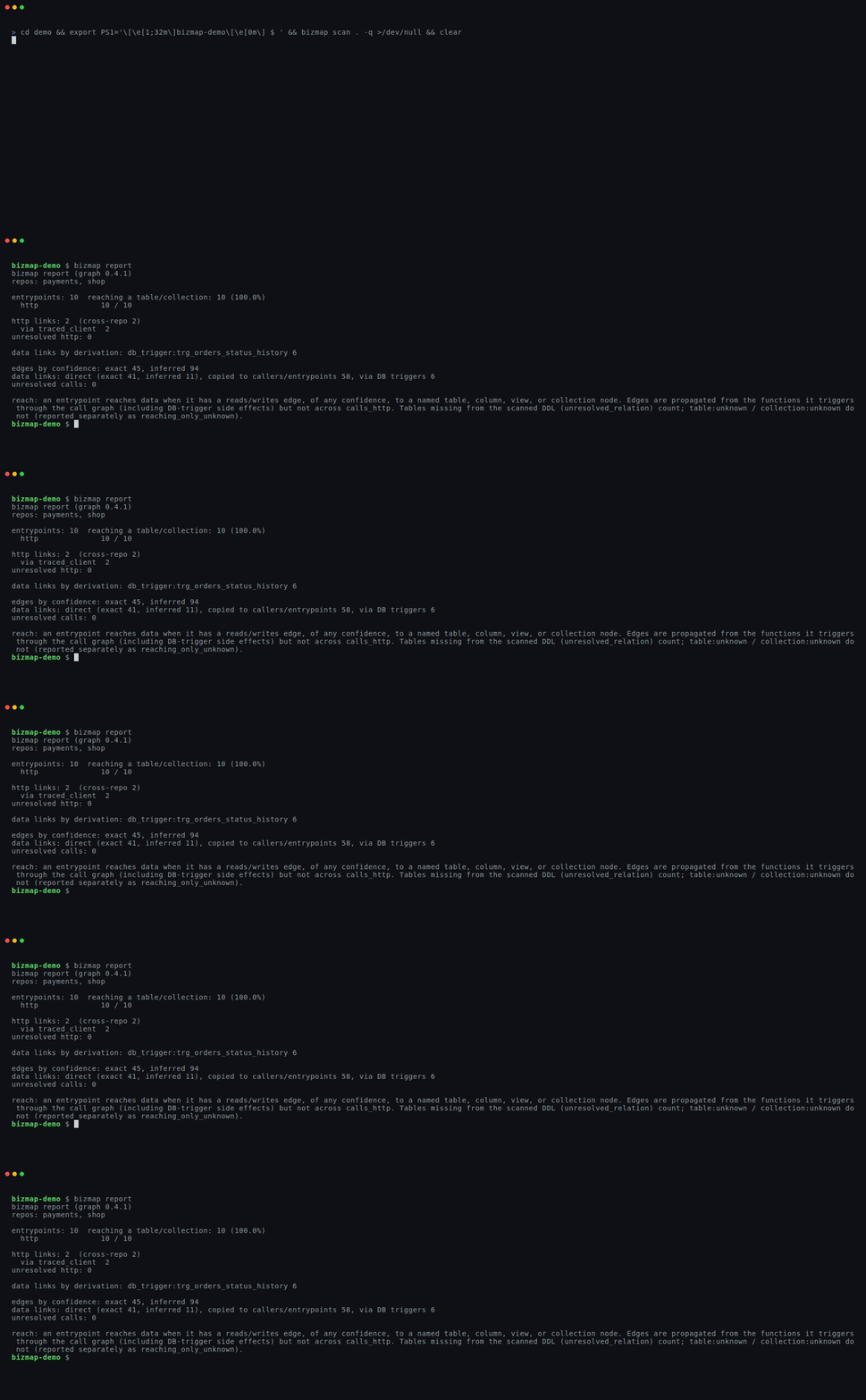
$ bizmap report
bizmap report (graph 0.4.1)
repos: payments, shop

entrypoints: 10  reaching a table/collection: 10 (100.0%)
  http              10 / 10

http links: 2  (cross-repo 2)
  via traced_client  2
unresolved http: 0

data links by derivation: db_trigger:trg_orders_status_history 6

edges by confidence: exact 45, inferred 94
data links: direct (exact 41, inferred 11), copied to callers/entrypoints 58, via DB triggers 6
unresolved calls: 0
When the graph has feeds
edges, a data flow between databases section follows: how many feeds,
how many have columns mapped, the exact / heuristic share, and one line per
database pair:
data flow between databases: 2 feeds, 2 with columns mapped, 6 column mappings (exact 4, heuristic 2, 67% exact)
  orders_db -> orders_db: 1 table, 2 columns (exact 0, heuristic 2)
  orders_db -> summary_db: 1 table, 4 columns (exact 4, heuristic 0)
Use it on a new codebase before trusting why or the PR comment: a low
"reaching a table" share or many unresolved HTTP calls usually means a
missing services: entry, a service that
was not scanned, or a framework BizMap does not know yet.
Options
| Option | Meaning |
|---|---|
--graph PATH |
Graph to report on (ignored when PATH roots are given). |
--config PATH |
bizmap.yaml for PATH scans. |
--json |
The report as JSON. |
--limit N |
Max rows per list (default 20). |
--cross-service |
Count entrypoints that reach data only through another scanned service (calls_http) as reaching data. |
--mermaid |
Append the architecture and each queue / trigger flow as Mermaid diagrams (details). Not with --redact or --json. |
--redact |
Replace every name, route, table, URL, env key and file with a salted hash. |
--salt TEXT |
Salt for --redact (or env BIZMAP_REDACT_SALT). Same salt, comparable runs. |
--salt-file PATH |
Read the salt from this file, creating a private random one (mode 0600) on first use. |
Sharing a report from private code
Only counts, edge types, entrypoint kinds and reasons stay readable, so the report can be attached to an issue without sharing code. Without a salt each run uses a random one and hashes differ between runs.